Friday, July 4, 2014

Dinner at Llanes Town

The district just outside the Old Town consists of narrow streets  lined by shops mostly cafes, bars, restaurants and souvenier shops. The group decided on a restaurant and settled down for dinner. The set menu was good beyond our expectations. The starter courses were large and as good as the main course. Wines that came with the dinner was poured generously as much as you like. Even had a round of the local digestif after dinner. And all that for about Euros 12 each.


 a grilled eggplant with beef fillings?

 my choice of the starter was a large plate of tender juicy calamari rings


 prawn salad starters


 my choice of the main course - merluza fillet in local herbal sauce

 this is like the tiramisu but has nuts in it as well

 the local herbal digestif
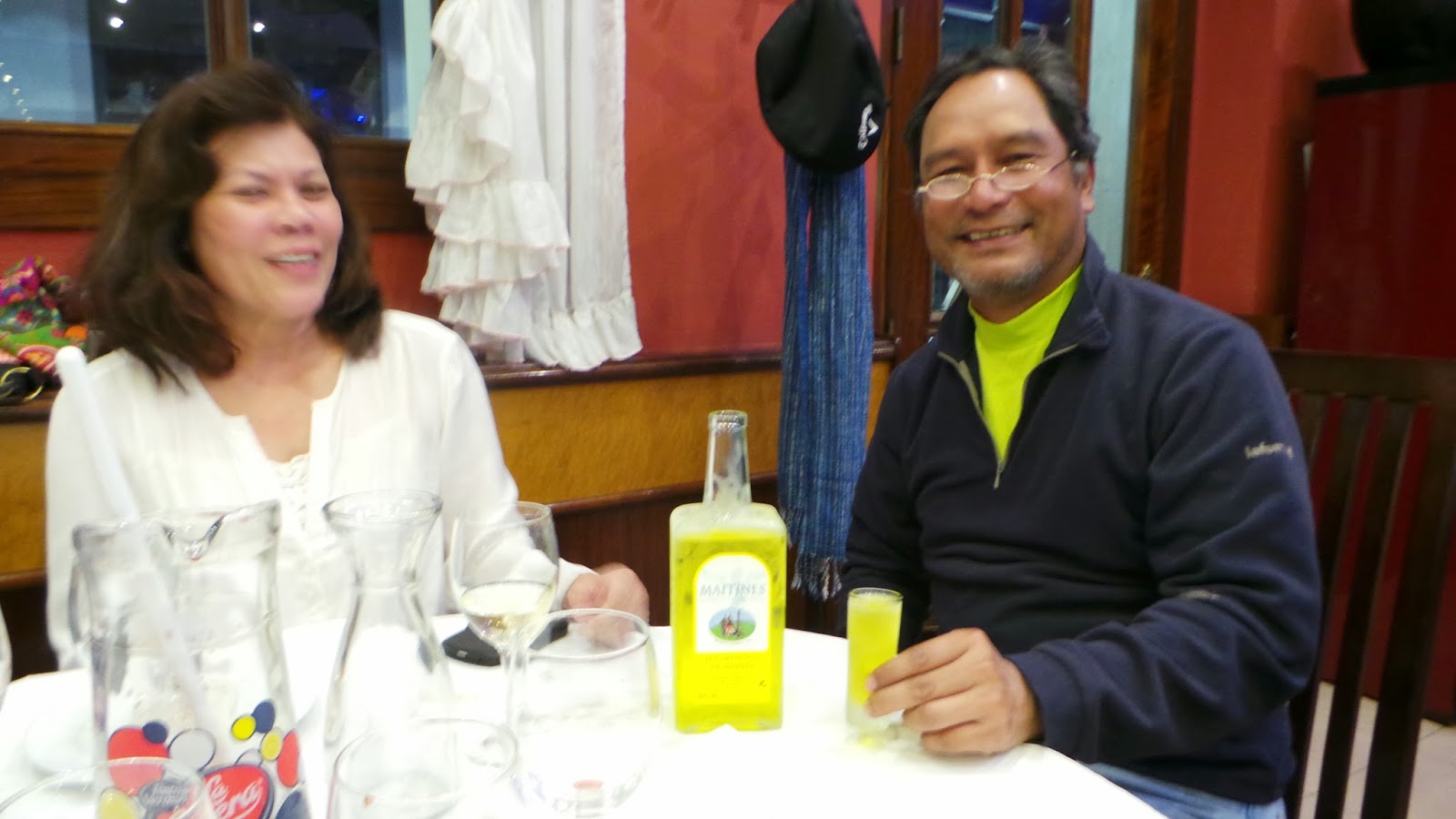
 happy and satisfied diners


The Llanes Old Town

The Llanes Old Town goes back to the 13th century. The defensive wall, the defensive tower and later the Basilica de Santa Maria were completed in 1480. The tower later became a prison. However much of the Old Town was destroyed during the Napoleonic War. Today the Tourist Information Centre is located in one of the buildings( The Defensive Tower)  in the Old Town.


 the Tower is now the Tourist Centre

 the Basilica de Santa Maria


Thursday, July 3, 2014

To the San Pedro (St Peter) Maritime Walk

Being in the centre of the Posada Hererra Gardens - the streets around Hotel Don Paco are lined by greeneries which I imagined in the height of summer would provide a full canopy against the strong sun. A short walk away from the hotel took us to the San Pedro Walk - a maritime passage built on the cliff overlooking the sea. It was built in 1847 from donations by the rich folks of the district especially from those who had made it rich by exploring to the Americas.

Llanes was a big fishing port - it was the centre for whale fishing. The catch would be brought back and off-loaded at the Sablon Bay where it would be cleaned and cut for sale. The Sablon Beach is today a white sandy beach for the townsfolk to come and swim and sun-bathe.

Many movies have been made in Llanes - our hotel for one had been host to Dustin Hoffman and Sam Peckinpath. The natural beauty of this town is understandably why it is a common director's choice for their films.


 steep cliff down from the San Pedro Walk


 seen from the San Pedro Walk - the town and the mountains beyond


 Sablon Beach


Overnight at a Parador in Llanes - Hotel Don Paco

We left Poncebos by the same bus again to Llanes for an overnight stop. Our hotel is a parador developed from a Baroque convent. According to Vero, it was built by  the Queen with donations and taxes especially from the many rich Indianos from the region. The Queen  later became a nun and moved to stay in a convent in Oviedo. This convent has now been converted into a parador.

The hotel is located in the centre of Llanes, surrounded by the Posada Herrera Gardens and just a short walk away from the Old City, the Maritime San Pedro Walk and the Sablon Beach.  


 the facade of the Don Paco Hotel


 dining in the open on sunny summer days

 old historical map of the town

 modern en-suite rooms

 a venue for jazz concerts

 night scene of the hotel


Tuesday, July 1, 2014

Walking Down from Bulnes to Poncebos

Tuesday 3rd June 2014

While most of the group members went down by the funicular train - 4 of us, John, Malcom, Robert and I decided to walk the trail down from Bulnes to Poncebos. It took longer than Vero estimated - probably because we walked quite slowly actually. The trail was at least one metre wide. Only at some stretches was it really tightly skirting a steep mountain wall with a deep gorge below. We took almost 3 hours to reach down instead of the estimated 2 Vero told us. Many parts were steep downhill and uphill climb. By the time we finished I was really tired and fatigued and was quite happy to treat myself to a bottle of chilled beer.

These mountains are of limestones and over millions of years have been carved and shaped by glaciers. It is most beautiful during sunset and the rays of the sun gives it the orange hue which gives it the commonly called name of Naranjo de Bulnes ( Orange of Bulnes) Before the construction of the funicular train - the trail we walked down was the way the villagers of Bulnes go and and come up from and to their village. General Franco made his prisoner-of-war work on widening these trails to enable hydro-electric dams to be built along the river.